
Woman SG
Campaign to Elect a Woman UN Secretary - General


We now have a LinkedIn page.
Take a look:
ivonne a-baki interactive dialogue

The interactive dialogue with Ambassador Ivonne A-Baki, candidate for UN Secretary-Generalon August 20th, focused on her vision for renewing the United Nations and making it more active, trusted, and people-centered. Ambassador A-Baki spoke about her personal experience living through war in Lebanon with her children. This was one of the most powerful parts of her message because it showed that her commitment to peace is not only professional, but deeply personal. She said that after surviving war, she promised to dedicate her life to peace.
Her main message was that the UN must do more than talk. It must act earlier, prevent conflict, and show real results. She believes the Secretary-General should not only sit in New York, but go to conflict areas, speak directly with leaders, and help bring people to the table before crises get worse.
She also called for reform of the Security Council, saying it still reflects the world of1945 and does not represent today’s global reality. She strongly supported better representation for Africa, small states, and the Global South.
On development, climate change, and financing, she said the UN needs to rebuild trust by proving that money and programs lead to real results. A-Baki also spoke strongly about women, children, youth, civil society, and vulnerable communities. She said she is not a feminist but supports women and said women should be included in peace negotiations because they bring a different and necessary perspective.
Overall, Ambassador A-Baki presented herself as a warm, independent, and practical leader. Her message was simple: the UN is still needed, but it must become less bureaucratic, more united, and more focused on action. In my view, her strongest points were her personal commitment to peace, her focus on prevention, and her belief that the UN must listen more and deliver real results.
Women Nominated for Secretary General:

Kingdom of Tonga nominated Ecuadorian diplomat Ivonne A-Baki as a candidate for UN Secretary-General.
On August 18, 2026, the island Kingdom of Tonga nominated Ecuadorian diplomat Ivonne A-
Baki as a candidate for UN Secretary-General. She is the eighth nomination for the position and
the fifth woman.
Ivonne A-Baki is an Ecuadorian diplomat, artist, peace negotiator, humanitarian, and politicianwith an extensive career in international affairs and public service. She studied art at Sorbonne University and earned master’s degrees in Public Administration and Public Policy from Harvard-Kennedy School. She is fluent in English, Spanish, French, German, and Arabic. Ivonne A-Baki lived in Lebanon for roughly 15 to 19 years after moving there at age 17, following her marriage to Sami A-Baki. She stayed through the start of the Lebanese Civil War and also served as Ecuador's honorary consul in Beirut.
Ambassador A-Baki has served as Ecuador’s Ambassador to the United States and Qatar, as well as
Non-Resident Ambassador to several Middle Eastern countries. From 2003 to 2005, she became the first woman to serve as Ecuador’s Minister of Foreign Trade, Industry, Regional Integration, Fisheries, and Competitiveness. She also represented Ecuador in the Andean Parliament and contributed to the historic 1998 peace agreement between Ecuador and Peru. A UNESCO Goodwill Ambassador for the Dialogue of Civilizations, she has dedicated her career to diplomacy, peacebuilding, intercultural dialogue, sustainable development, andenvironmental protection.

Carolyn Rodriguez-Birkett Nominated to be Next UN Secretary - General
Guyana’s current Permanent Representative to the United Nations, Carolyn Rodrigues-Birkett, has been nominated as the country’s candidate for the position of Secretary-General of the United Nations (UN). President Dr. Irfaan Ali announced the nomination during a national broadcast on Friday evening, stating that the decision followed careful consideration and consultations with experts.
The president said the nomination comes at a time when Guyana’s international standing continues to grow. He pointed to the country’s increasing prominence on the global stage, including its recent tenure as President of the United Nations Security Council (UNSC) last year. President Ali said the nomination reflects Guyana’s confidence in Rodrigues-Birkett’s extensive diplomatic experience and leadership at the international level.

Maria Fernanda Espinosa Garcés, Nominated for UN Secretary General by Antigua and Barbuda
As of May 12, 2026, Antigua and Barbuda has officially nominated Maria Fernanda Espinosa Garcés, former President of the UN General Assembly and Ecuador's ex-Foreign Minister, as a
candidate for the next United Nations Secretary-General. She is the fifth candidate in the race to succeed António Guterres, whose term ends December 31, 2026.
María Fernanda Espinosa Garcés is a distinguished Ecuadorian diplomat, politician, and academic with over 20 years of experience in international relations and multilateral negotiations. Born on September 7, 1964, in Salamanca, Spain, and raised in Ecuador, she holds a Master’s Degree in Social Sciences and Amazonian Studies and a postgraduate degree in Anthropology and Political Science from the Latin American Faculty of Social Sciences (FLACSO) in Quito.
Espinosa has held several high-ranking positions in the Ecuadorian government, including twice serving as Minister of Foreign Affairs, as well as Minister of National Defense, and Coordinating Minister of Natural and Cultural Heritage. She coordinated the Sectorial Council on Foreign Policy and Promotion, overseeing the Ministries of Tourism, Culture, Heritage, Foreign Trade, and the Environment.
On June 5, 2018, Espinosa was elected as the President of the 73rd session of the United Nations General Assembly, making her only the fourth woman and the first Latin American woman to hold this prestigious position.Her tenure focused on gender equality, the rights of indigenous peoples, and environmental sustainability. As Chair of the Group of 77 and China, she played a critical role in advancing the interests of developing countries. Espinosa was the first woman to serve as Ecuador’s Permanent Representative to the United Nations in New York, where she co-facilitated the revitalization of the General Assembly’s work. She also held the role of Permanent Representative to the UN in Geneva, where she led negotiations at the Human Rights Council and chaired the Community of Latin American and Caribbean States (CELAC). Her contributions to global environmental policy include leading Ecuador’s negotiations at the United Nations Framework Convention on Climate Change (COP 16 and 17) and facilitating key elements of the Rio+20 outcome document, “The Future We Want.” She also promoted the resolution “Indigenous women: key actors in poverty and hunger eradication” at the 56th session of the Commission on the Status of Women. Fluent in Spanish, English, and French, Espinosa’s legacy is defined by her unwaveringcommitment to multilateralism, social justice, and environmental protection, making her one of the most influential women in global diplomacy.

Rebeca Grynspan of Costa Rica Nominated for UN Secretary-General
Costa Rica has nominated Rebeca Grynspan as a candidate for United Nations Secretary-General. Costa Rica’s Ministry of Foreign Affairs and Worship announced the nomination on
March 3, 2026. She is the second woman nominated in the current selection process, following Michelle Bachelet of Chile.
Grynspan has served as Secretary-General of the United Nations Conference on Trade and Development (UNCTAD) and previously held senior roles in the UN system, including as Associate Administrator of the United Nations Development Programme.
She has also served as the Vice President of Costa Rica.
She has indicated that she has chosen to step away from UNCTAD during hercampaign for Secretary-General. Her candidacy presents an experienced leader with a long record in multilateral cooperation and global development.
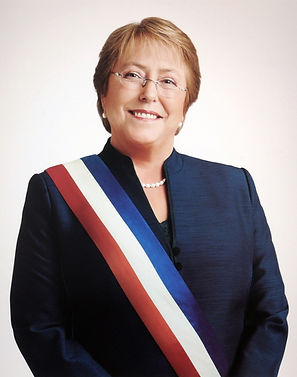
Michelle Bachelet of Chile Officially Enters UN Secretary-General Race
On February 2nd, 2026, Chilean President Gabriel Boric nominated Michelle Bachelet as a candidate for UN Secretary-General along with Brazil and Mexico.
Bachelet brings decades of experience as a two-term president of Chile and as a senior UN leader, including her roles as High Commissioner for Human Rights and head of UN Women.
She has consistently promoted democracy, human rights, and multilateral diplomacy, making her a notable, experienced, and internationally recognized candidate.
NOTE: In early March, Chile withdrew its nomination; however, Brazil and Mexico continue to support her as a candidate.

Virginia Gamba of Argentina Nominated by the Republic of Maldives for UN Secretary-General
On March 12, 2026, the Republic of Maldives nominated Virginia Gamba of Argentina as a candidate for United Nations Secretary-General. She joins the growing list of candidates in the
current selection process.
Ms. Gamba served as Special Representative of the UN Secretary-General for Children and Armed Conflict from 2017 to 2025. Throughout her career, she has held senior roles across the
UN system and international research institutions, focusing on conflict prevention, disarmament policy, and international security, including leadership positions at the United Nations Office for Disarmament Affairs and the United Nations Institute for Disarmament Research.
Her candidacy presents an experienced leader with a strong record in multilateral diplomacy, peace and security,and the protection of children caught up in armed conflict.
NOTE: At the end of March, the Maldives withdrew its nomination, however another country may be stepping up.
Main Points from the Interactive Dialogue with Ambassador Maria Fernanda Espinosa, Candidate for UN Secretary General
June 15, 2026
The interactive dialogue with Ambassador Maria Fernanda Espinosa focused on her vision and priorities as a candidate for UN Secretary-General. Member States and civil society asked about UN reform, peace and security, development, human rights, climate change, accountability, and representation.

Ambassador Espinosa described the UN as “our home” and said it belongs to all Member States and peoples. She recognized the gap between the promises made at the UN and the real actions people see in their lives. She said that words can give hope, but without action, words are empty. Drawing on her experiences as Ecuador’s Foreign Minister, Minister of Defense, President of the General Assembly, and Permanent Representative to the UN from Ecuador, she presented herself as someone who understands both the strengths and weaknesses of the UN.
Her main message was that the UN must gain trust by proving its value every day through real results. She said the organization must act earlier, deliver better, and focus more directly on people’s needs. One of her strongest priorities is prevention. She proposed creating a Prevention and Early Action Hub in the Secretary-General’s office to help the UN respond quickly before crises become worse.
She stressed that this would not be a new bureaucracy, but a practical 24/7t ool to support diplomacy, good offices, and early action. She is willing to undertake any shuttle diplomacy that would advance peace. The Secretary-General must lead, listen and act early to find peaceful solutions.
On development, Espinosa said the Sustainable Development Goals are important, but ambitionalone does not feed children or stop sea levels from rising. She argued that development must benationally led, demand-driven, and supported by a leaner UN. She said the UN can use itsconvening power to address finance, debt, energy, technology, and AI, but must ensuretechnology serves everyone, not just the few.
_edited.jpg)
Climate change was a major concern, especially for small island states and vulnerable countries. Espinosa called climate change an existential threat and supported easier access to climate finance, more funding for adaptation, and stronger implementation of existing commitments. Many questions focused on UN reform. Espinosa supported the UN80 process, mandate review, and reducing duplication, but said reform must strengthen the UN, not weaken it. She also said financial pressure is often a consequence of deeper problems. For her, reform must make the UN more effective, accountable, and useful.

Human rights, international law, and accountability were also central. The three pillars of the UN: peace and security, development, and human rights, are all mutually reinforcing. She was concerned that only 1% of the budget is currently spent on human rights. Human rights and dignity are at the center of the UN. She promised to be impartial and independent, while always guided by the UN Charter and international law. However, compliance depends on the actions of Member States. On crises such as Ukraine and Palestine, she emphasized the need for security, diplomacy, humanitarian law, protection of civilians, and support for accountability mechanisms.
She encouraged lasting peace in the Middle East, which includes security for Israel and justice and security for the Palestinian people. Support for UNRWA and its humanitarian access is key and emanates from the UN General Assembly.
Representation and fairness were repeated themes. Espinosa said the UN should be “the mirror of all of us.” She committed to improving regional and gender balance in senior positions, especially for underrepresented regions. She recognized Africa’s request for permanent Security Council representation and fair support for African-led peace operations, but cautioned that these decisions must be made by the Member States. She also defended the role of small states, saying greatness is not measured in square kilometers.
Civil society, youth, and multilingualism were also discussed. Espinosa supported meaningful civil society engagement, clearer public communication, and stronger youth participation. She also said multilingualism is tied to the sovereign equality of states and should be respected throughout the UN. As an example, she speaks fluent French, Spanish, and English. Overall, Espinosa presented herself as an experienced and pragmatic leader who skillfully carries herself with diplomacy and charisma. Her message was that the UN must act earlier, reform responsibly, defend the Charter, and prove its value through real impact on people’s lives.
Presentations by Women Candidates for Secretary-General
(SG): April 21 and 22
Tuesday, April 21: Michelle Bachelet Jeria, 10:00 – 1:00
Wednesday, April 22: Rebeca Grynspan Mayufis, 10:00 – 1:00
The Format for all Presentations:
The President of the GA, Ms. Annalena Baerbok, introduced the candidates and set the rules for their presentations and the order of questions from Member States. The sessions lasted three hours. Each candidate made about a 10-minute opening statement, followed by questions from Member States. The first segment consisted of 2-3 minute questions by a member that represented a group of states. Some of the groups were: Group of 77plus China, the EU, Landlocked Developing States, Arab States, Pacific Island States, BENELUX countries, Small States Group, Group of Four (Germany, Japan, India, and Brazil),Non-Aligned Movement, Friends of the Rule of Law Group, CARICAM, Least Developed Countries (LDCs), Portuguese-speaking Countries, and the Africa Group. Civil society was represented separately by GirlUP, by One for Eight Billion, and by ICAN (International Campaign to Abolish Nuclear Weapons). The second segment consisted of individual Member States, which were allowed 2-minute questions. The candidates were given a few minutes after each question to respond. Time limits were strictly enforced with microphones being cut off for all speakers when their time was up.
Michelle Bachelet Jeria (nominated by Brazil and Mexico)
In her introductory presentation, she stated that the rule of law is under stress and there is a need to uphold human principles with practical responses and dialogue for peaceful solutions based on trust. The world faces problems of Climate Change and human rights, where the UN is the only “house” in which all can share goals and promote a common moral compass. Sheemphasized that we need to reconnect with the peoples of the world, defend human rights, and shape our collective future with human rights as the center. Her wide-ranging experiences as president of Chile twice, the first head of UN Women and High Commissioner for Human Rights offer a depth of knowledge that would reinforce her work as Secretary-General.

In response to questions (summarized here in general):
She stated that her priority would be to uphold the three main pillars of the UN: peace and security, development, and human rights. There is no peace without development and the protection of human rights. The UN spends only about one percent of its budget on human rights, and that must change. She strongly supported the enhancement of the UN’s resident coordinator system and country teams to effectively fulfill the responsibility of country-based development. The SG has to have “field presence” for prevention(be present). For landlocked countries, she stated that geography should not direct development. She also proposed reform of the OECD to offer more support for development. In response to an inquiry on the Palestinian Question, she stated that prevention of conflict before it breaks out is key, and in order to do that, the SG must be present. The SG has to have a moral voice, protect humanitarian assistance, and garner support from Member States for multilateralism. Unilateral coercive measures do not help a crisis but exacerbate peace. Peaceful solutions require dialogue.
She emphasized that she would include and support youth at the UN and was asked by civil society if she would commit to the One for Eight Billion stated “Principles.” While she did not directly answer that question, she again stated that you have to be present. The UN must identify and prevent conflict, coups d’etat, and hate speech. She stated strongly that the UN must have the capacity to observe if justice is not working. Ms. Bachelet emphasized that climate change is the biggest threat to society, and the UN should support the findings of the IPCC (Intergovernmental Panel on Climate Change) and the Paris Agreement Conference of Parties’ (COPS) call for a Loss and Damage Fund. Regarding diversity among Secretariat staff, she identified the need for geographic and linguistic diversity to represent the world, plus gender parity. She said she would build upon “UN 80,” The Pact for the Future, and the Agenda 2030 SDG goals. The right to development is essential, and as SG, she would focus on development finance and human rights, which are interdependent with the right to development. If you want trust in the UN, then you have to deliver results. Trust is built on accountability and transparency.

She stated that it is a difficult time for the UN and any reform must be owned by the MemberStates. Security Council reform is needed in order to represent the world of today and she wouldoffer the “good offices” of the SG to meet with Member States and build consensus. However,she explained that it is not up to the SG to make this decision. Reform should be continuous, nota one-time issue.The UN needs to have good access to all of the six official languages. The staff have to havegreater linguistic skills and more outreach in languages to strengthen multilateralism. Staff alsoneed more mobility between field work stations and headquarters. Africa is a priority. Foodinsecurity can be a source of conflict and the UN should do a better job of support for agricultureand water supply, even utilizing AI.

Bachelet’s strongest points: her emphasis on Climate Change as the greatest threat to society,strengthening human rights and gender parity, creating staff appointments that representgeographic representation and linguistic diversity, including under-represented countries. Herdepth of global knowledge on these factors and the whole UN system was very apparent.
********************
Rebeca Grynspan Mayufis (nominated by Costa Rica)
In her opening remarks, Ms. Grynspan explained that peace is in peril and the UN is under stress. Her priorities are peace, reform, and forming a strong future. The UN has to be back at the table of peace, safe from nuclear arms and weapons of mass destruction, and return to multilateralism in a multipolar context and away from uncertainty with the understanding thatoceans rise on all shores. The future has room for all, and the UN must work to lift people out of poverty, but it cannot work alone. There is always a choice, and she chooses peace and reform for the future.
The UN must also address organized crime and terrorism. Peacemaking is her first priority, but it takes persistence, and she would travel to war areas. As an example, she discussed her work to help organize the grain agreement on the Black Sea with Russia, Ukraine, and Turkey to enable the safe passage of Ukrainian ships carrying grain to help feed many parts of the world. Peacekeeping is an important aspect of the UN’s activities and has to be supported. Like in Haiti, the UN has to meet the needs of the people.
Her work as the Secretary-General of UNCTAD (UN Conference on Trade and Development), as well as her prior experience as vice president of her country, head of the Ibero-American Conference, and Deputy Administrator of UNDP demonstrates her broad expertise and experience as well as her ability to build trust with Member States.
In response to questions: We have to build on UN 80; there have to be reforms to avoidduplication, therefore, cuts are not enough as an answer. She stated that she understood thedevelopment problems countries are going through. The financial system must work on debtrelief. She said she was very familiar with the concerns of landlocked countries and would worktoward a concept of “landlocked to landlinked” so countries have links to deliver goods tocoastal areas. But again, there is a need for cooperation among Member States for capacitybuilding. For small states, she also added that our strength is in our cooperation, the rule of lawand multilateralism. The UN must help the Least Developed Countries (LDCs). Servicing thedebt for these countries is at about 22 percent of their annual income while Financial DirectInvestment (FDI) is only two percent. She added that 3.5 billion people spend more on debt thanon education. The banks can lower the risks for investment.

The SDGs are only about 18 percent on track. The SDGs must be fit for purpose at the country level and should not be supply-driven, but needs-driven. She would fully support the needs of small island developing states. Development requires stronger support for the in-country resident coordinators and country teams who deliver on the ground. In her role as Minister of Finance inCosta Rica, she described that she has dealt with financial issues her whole life. She would begin on day one to ask for the numbers. She would engage with resident coordinators, country teamsand Member States to build a strategy.

On climate change, Ms. Grynspan recognized that Small Island Developing States (SIDS) suffer the most. Climate disasters hit SIDS four times more than other countries, and they must receive support for adaptation and mitigation.
She said that the SG can be independent but must cooperate with Member States. Multipolarity is a reality, but we need to enhance multilateralism. We must strengthen the General Assembly and reform the Security Council. She explained that there are underrepresented regions that need deeper partnerships within the UN, and Member States will have to work toward convergence.
Countries have more capacities today than in 1945. She also discussed the importance of regional and cultural diversity and the expansion of multilingualism within the UN Secretariatstaff. There also needs to be gender parity, and UNCTAD has achieved it at the highest levels. Women make up 51 percent of the world and should be represented.
Ms. Grynspan explained that Article 99 is essential, but constant engagement with the Security Council is also important. She would meet regularly with the Council and would work for convergence, even attending consultations. She would speak more candidly with Councilmembers. She would also meet regularly with the Special Envoys, as knowledge of situations on the ground is imperative.
When asked about the Palestinian question, she stated her support for the cease-fire, unrestricted access of humanitarian aid to Gaza, and that the two states, Israel and Palestine, live together in peace and security. She pushed back against the use of humanitarian aid as a weapon. All parties to the conflict, she said, should comply with international law. Also, in response to a question by Ukraine on her recent visit to Moscow, she explained she has to engage with all P-5 members to mediate a peaceful solution to the conflict, as she had done when mediating between Russia, Ukraine, and Turkey on the Black Sea agreement on the export of grain.
Ms. Grynspan emphasized that trust is essential and must be restored among Member States. Trust is difficult to build but easy to destroy. A leader has to be trusted and be independent, but without acrimony. She would use the “good offices” of the SG to help forge an agreement through mediation. She would form flexible teams and restructure the office of the SG to ensure regional diversity, multidisciplinary expertise, and a proactive approach. Communication within the UN and with civil society must be better, and this will be a priority for her going forward. She stated that we must do this together, be tough, clear, and take collective action.

Human rights and UN peacekeeping must be supported. Only providing one percent of the UN budget toward human rights is a travesty. Human rights violations demonstrate a need for humanitarian aid, but humanitarian aid should not be politicized. More than one thousand humanitarian aid workers have been killed in the last three years. Legal frameworks must protect migrants as well as refugees. There is too much pressure on peace operations to cover all the needs of a struggling country; the tasks are piled on like decorations on a Christmas tree to try to do everything all at once. So, peace operations need clearer mandates. She emphasized that the UN Charter is not a menu (where you choose what you want); it is a package, and human rights are key. Monitoring human rights violations is the best means to gather early warning information for prevention. She concluded that our strength is in our cooperation, the rule of lawand multilateralism.
Grynspan’s strong points: Her depth of knowledge of the UN system and experience as an economist, development and finance expert offer unique leadership qualities useful to her candidacy. The fact that she had successfully overseen the reform and cost-cutting in UNCTAD is also helpful to the UN at this critical time. Her dedication to multilateralism and the rule of law, coupled with her ability to articulate clear and concrete ideas and strategies, is impressive. She speaks very clearly, appears energetic, and has language skills in English, Spanish, and French, useful because she is committed to communicating regularly about the work of the UN. While she held up well during the 3 hours, she joked at the end that she was about to faint.
_edited.jpg)
The Best Man for the Job is a Woman
by Mona Ali Khalil
After last week’s dialogues with the four current candidates for UN Secretary-General, Rebeca Grynspan of Costa Rica and Rafael Grossi of Argentina emerged as the two main contenders for the job. Michele Bachelet of Chile is unlikely to get to the finish line without her government’s support. Similarly, Macky Sall of Senegal also has little to no chance without the support of the African Union.
Based on their past record and recent presentation to the General Assembly, it is fair to say that Grossi raised more doubt while Grynspan inspired greater confidence.
Grossi relied on platitudes and repeatedly stated that he was the only candidate with the charm and capability to save the United Nations. He consistently claimed that, in his current role as Director-General (GD) of the International Atomic Energy Agency (IAEA), he made critical contributions to peace in Ukraine and Iran. Not only is there no peace in either country, Grossi's role has also been controversial.
While Grossi has led the IAEA's efforts to ensure the safety of the nuclear power plant in Zaporizhzhia, his approach has been criticised for endangering IAEA staff, allowing the plant to be used as a weapon of war, undermining Ukraine's territorial integrity, and promoting the narrative that Ukraine must give up part of its territory to secure peace with Russia. Unlike the former directors general of the IAEA, the esteemed Hans Blix and Mohamed Elbaradei -- who stood firmly and bravely against the big powers, Grossi has catered not only to Russia on Ukraine but also to the US on Iran.

Moreover, during his time in office, the 2022 NPT review conference failed in August 2022, the JCPOA was terminated in October 2025, and the last remaining treaty between the United States and Russia that limits the number of nuclear weapons expired in February 2026. While he is not responsible for these events, he cannot claim that his tenure has been a success. In fact, from a nuclear perspective, the world is less safe during Grossi’s tenure. The Bulletin of the Atomic Scientists has even set the "Doomsday Clock" at 85 seconds to midnight, the closest it has ever been to global catastrophe.
The one or two times Grossi mentioned the UN Charter, he pulled it out of his coat pocket as if it were a mere prop. He displayed a superficial understanding of the UN and its three pillars. None of this bodes well for his leadership of the United Nations at this critical juncture.
Like Grossi, Grynspan is the executive head of a multilateral organization that has achieved gender parity. Unlike Grossi, and in keeping with the UNGA’s wishes, she has stepped away from her role as Secretary-General of the UN Conference on Trade and Development (UNCTAD) while Grossi continues to campaign while serving as the DG of the IAEA.
He helped build the case for military action against Iran. Instead of emphasising the IAEA's clear and consistent conclusion that there is no credible evidence of a nuclear weapons programme in Iran, he focused on past questions and amplified future risks of Iran’s nuclear power programme. This was on public display in his press interviews, where he helped beat the drums of war - a rather odd posture for someone seeking to lead an organization devoted to the pursuit of peace.
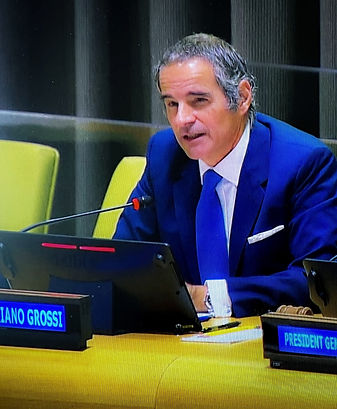
Her long and impressive record of public service demonstrates that she is much more than her current role. She has critically relevant experience as a former Vice-President of Costa Rica, SG of the Ibero-American Conference and Associate Administrator of the UN Development Programme (UNDP). She is an economist when the global economy is facing major crises; a negotiator when the world is facing multiple conflicts; and an intellectual who has a solid grasp of the UN's three pillars. She did not spew jargon about peace and security, human rights and development; she captured their interdependencies structurally and operationally. Most tellingly, she understood that human rights violations and denial of basic needs were an early warning of threats to peace and security.
She knows the UN system - both what is right and what is wrong with it.
She displayed clear knowledge of current events across a spectrum of subjects; provided analytics to respond to the many crises in each region of the world, and offered concrete ideas to restore confidence in multilateralism. She repeatedly referred to the UN Charter and to the fundamental principles of international law. Most importantly of all, she had the courage to say that the major powers were flouting international law. She emphasized the need to ensure “no bias, no discrimination, no politicization,” of humanitarian aid. She spoke substantively about climate change and other existential threats, about the 2030 Agenda for Sustainable Development and other issues affecting the Global South, as well as about the important contribution of regional organizations to peacemaking and peacekeeping, especially the African Union. Finally, where Grossi wanted to forge personal friendships, Grynspan sought to build institutional partnerships not only with member states but also with youth and civil society. Ultimately, she pledged to be an impartial leader that represents all member states and all peoples. She promised to uphold the UN Charter equally without discrimination or double standards.
Based on what he said and what she said, it became clear that the best man for the job is a woman.
______________________________________________________________________________________________________

Mona Ali Khalil is a member of the Core Planning Committee for the Campaign to Elect a Woman UN Secretary-General. She is the Director of MAK LAW International, an Affiliate of the Harvard Law School Program on International Law and Armed Conflict, a non-resident member of the faculty of law at the Vienna Diplomatic Academy and a former Senior Legal Officer of the United Nations and of the International Atomic Energy Agency.


A group of like-minded women and men have come together to launch a campaign to elect a woman as UN Secretary-General when António Guterres steps down at the end of 2026. There have been nine male Secretaries-General but never a female even though women represent half the world’s population. The group represents women and men from academia and civil society with a long record of engagement with the United Nations. Through an initial series of discussions, we decided that the time had come for a woman to lead the Organization and we formed a core planning group to enact a plan of action. We welcome others to join the campaign, both men and women, individuals and organizations alike. It’s time!


GIVING A VOICE TO THE VULNERABLE


WomanSG Core Planning Committee
CHAIR:Jean Krasno
Charlotte Bunch, Distinguished Professor Emeritus from Rutgers University and the Founding Executive
Director of the Center for Women’s Global Leadership.
Anwarul Chowdhury, Former ambassador to the UN and a creator of SC res. 1325; Former Under-Secretary-General and High Representative of the UN
Mercedes Mas de Xaxàs Faus,Consultant for UNFPA with 25 years of experience advocating for better policies for women and girls worldwide.
Kimberly Gamble-Payne, Formerly with UNICEF, Lecturer, City College of New York and George Washington
University.
Larry Johnson, Former Assistant Secretary-General for Legal Affairs, led the legal office for the IAEA and the
ICT for the former Yugoslavia. Currently: Professorial Lecturer at Vienna Diplomatic Academy.
Mona Ali Khalil, Director of MAK LAW International, Affiliate of the Harvard Law School Program on
International Law and Armed Conflict and former U.N. Senior Legal Officer
Jean Krasno (chair), Lecturer, Department of Political Science, City College of New York and Columbia
University; published Kofi Annan’s and Ban Ki-moon’s papers; conducted UN Oral History project.
Melissa Labonte, Associate Professor, Department of Political Science, Faculty Affiliate, Institute of
International Humanitarian Affairs, Fordham University
Deborah Landey, Former Assistant Secretary General, UNAIDS; Deputy Assistant Administrator and Director Office of Human Resources, Bureau of Management, UNDP
Anita Mathur, Former senior member of the United Nations Secretariat, and currently active on Executive
Boards and Advisory Councils of several non-profit organizations.
Ann Nicol, Executive Director, United Nations Association-New York City, UNA-NYC
Shazia Rafi, Currently President, AirQualityAsia, was the Secretary-General of Parliamentarians for Global
Action (PGA) from 1996-2013
Gillian Sorensen, Former United Nations Assistant Secretary-General for External Relations; National Advocate, United Nations Foundation.